
This post includes themes from Forisk’s FRQ research and the (virtual) Applied Forest Finance course on March 31st, 2026. Early registration ends March 17th*
Introduction
On February 28, 2026, the United States and Israel initiated joint strikes on Iranian and regional infrastructure targets. Ongoing airstrikes, cyber operations, and retaliatory attacks have spread, affecting families, trade, travel, and markets around the world. In particular, ongoing fears related to Iran’s blockade of the Strait of Hormuz and how this war disrupts energy supplies increased the price and volatility of global oil prices.
On March 11th, the oil price once again exceeded $100 per barrel, even as governments attempted to pacify markets by announcing plans to release emergency oil reserves. While extended higher oil prices translate into increasing costs throughout the economy as manufacturing and transportation of all goods become more expensive, how do they affect forestry products and timber?
Fuel Prices and Forest Products
In the forest products industry, rising oil and energy prices directly affect the costs of how firms make, move, and do things. Specifically:
Higher energy prices increase the break-even cost of making (manufacturing) forest products. Forisk tracks the cash costs associated with producing a range of forest products, including lumber, pulp, pellets, and structural panels (e.g., OSB and plywood). For most of these products in the United States, energy accounts for 7% to 20% of the per unit manufacturing (production) costs, which does not include the cost of wood raw materials nor the cost of transporting finished goods.
Higher oil and diesel prices increase the cost to move (haul) wood raw materials and finished forest products. In the case for hauling logs from the woods to wood-using mills, each $1 dollar per gallon increase in the cost of diesel increases the per ton hauling cost by $0.90.
Higher fuel prices increase the cost of doing things such as harvesting trees, fertilizing forests, and managing timberlands. Logging relies on heavy equipment powered by petroleum products. Each $1 per gallon increase in the cost of diesel increases the per ton logging cost by approximately $0.70. Combined with increased hauling costs, adding $0.70 per gallon to current diesel prices could increase southern cut-and-haul costs by more than $1 per ton.
Past Forisk Silviculture Surveys highlight factors affecting forest management practices in the U.S., including the sensitivity of fertilization costs to petroleum prices. Fertilizer price increases can take time to work through the system, as analysis by Dr. Shawn Baker indicates per acre costs closely mirror prior-year petroleum prices.
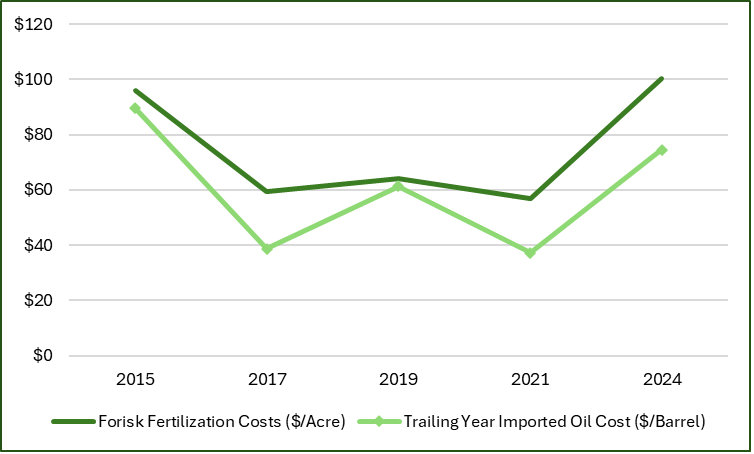
Sources: Forisk, EIA
Conclusions
In the forest industry, each part of the supply chain captures a piece of the end-product price paid by the ultimate user. When energy and oil take bigger shares of what a firm gets for a roll of pulp or stick of lumber, less is left over for the landowner, logger, or institutional shareholder. Higher oil prices, without commensurate increases in productivity or substitutions with other power sources, increase the out-of-pocket costs and reduce the margins, profitability, and sustainability of manufacturing, hauling, and in-woods operating activities in the forest industry.
#
*Class participants receive two updated books on Forest Finance
Forisk Finance Simplified, 7th Edition
This book distills forest finance themes into an accessible reference for analyzing timber investments and making forest management decisions. The new 7th Edition includes additional content on financial criteria, timberland investment benchmarks, and financial statements.
Why read Forest Finance Simplified? (19 second video)
Aunt Fanny Learns Forestry: Managing Timberland as an Investment
This 2nd Edition follows Aunt Fanny as she gets to know her recently inherited forest, learns investment concepts, and implements a forest management plan. The book serves any investor interested in a tight and entertaining tutorial for prioritizing what matters when managing their timber as an investment.
Leave a Reply