
By Henry Cozart, Forisk Intern
This blog includes an excerpt from the Q4 2026 Forisk Research Quarterly (FRQ), which includes forest industry analysis and timber price forecasts for North America. The post highlights data available in Forisk’s North American Mill Capacity Database. To learn more or to subscribe, please contact Nick DiLuzio (ndiluzio@forisk.com).
What is biochar?
Wood-based biochar is a carbon-rich solid produced through pyrolysis, which is the thermal decomposition of biomass under limited oxygen conditions. Depending on the processing conditions, many end products can be produced. Forisk reviewed the literature and classified biochar into two categories: agricultural biochar and biocarbon. These differ primarily in their target properties and end use requirements. Biocarbon products are engineered to meet strict industrial specifications, often requiring post-processing, while agricultural biochar has less stringent specifications.
Biochar has been used primarily as a soil amendment in agriculture and horticulture. Through the monetization of biochar carbon removal credits (BCR), new producers are entering the market. The American Biochar Institute (2026) reports that the U.S. biochar industry has grown with an estimated value of $157 million in 2025, up from $53.6 million in 2023. These figures exclude the North American biocarbon segment.
What is biocarbon?
Biocarbon used to replace coal and coke in electric-arc-furnaces, or metallurgical biocarbon, is viewed as a commercially viable and promising market. Metallurgical biocarbon investment activity includes the opening of SDI Biocarbon Solutions in Columbus, MS. The facility’s expected annual capacity is 251,000 tons, which Forisk estimates will require about 1.2 million tons of wood per year. Beyond metallurgical applications, biocarbon has potential use cases in concrete, asphalt, and carbon black for plastic and rubber, although many of these applications remain in earlier stages of development. Forisk is now tracking biocarbon facilities in the North American Mill Capacity Database, including production capacity and wood use volumes.
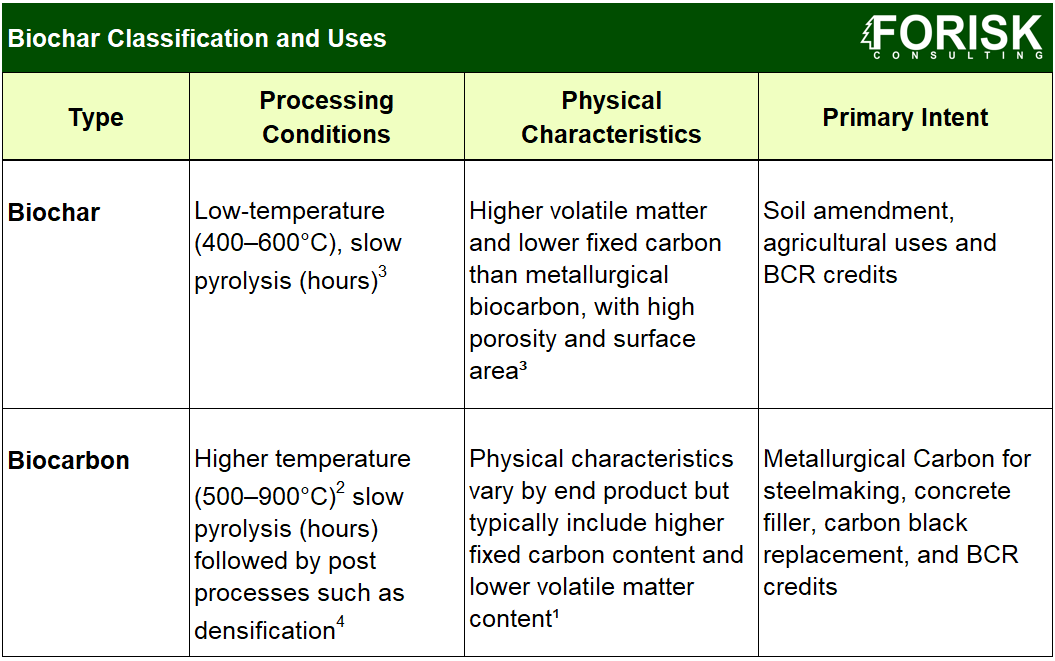
Figure: Biochar Classification and Uses
1Pahnila, M., Koskela, A., Sulasalmi, P., & Fabritius, T. (2023). A review of pyrolysis technologies and the effect of process parameters on biocarbon properties. Energies, 16(19), 6936.
2Pahnila, M., Koskela, A., Sulasalmi, P., & Fabritius, T. (2024). Biocarbon Production Using Three-Stage Pyrolysis and Its Preliminary Suitability to the Iron and Steel Industry. Energies, 17(13), 3131.
3Okiemute Akpasi, S., Michael Smarte Anekwe, I., Adedeji, J., & Lewis Kiambi, S. (2023). Biochar Development as a Catalyst and Its Application. In Biochar – Productive Technologies, Properties and Applications. IntechOpen.
4Kaffash, H., Surup, G. R., & Tangstad, M. (2021). Densification of Biocarbon and Its Effect on CO2 Reactivity. Processes, 9(2), 193.
To learn more about Forisk’s North American Mill Capacity Database click here. To learn more about the Forisk Research Quarterly click here or email Nick DiLuzio at ndiluzio@forisk.com.
Leave a Reply