
This post includes excerpts from the Q3 2026 Forisk Research Quarterly (FRQ), which includes forest industry analysis and timber price forecasts for North America. To learn more or to subscribe to the FRQ, please contact Nick DiLuzio (ndiluzio@forisk.com).
Year-to-Date Housing Activity
Seasonally adjusted annual rates (SAAR) for U.S. housing starts averaged 1.35 million in Q2, down 5% from Q1’s 1.42 million SAAR. Single family starts fell 4.6% to 902 thousand SAAR while multifamily starts declined 6%. Building permit activity also slowed, with Q2 2026 permits down 1% relative to Q2 2025 and down 2% from last quarter. New home sales were down 4.5% year-over year.
Near-term Housing Outlook
Our composite housing starts outlook projects flat housing starts over the next two years with a 0.5% increase in 2026, followed by a 0.5% decline in 2027 (Figure 1). The 2027 outlook anticipates 20 thousand fewer starts (-1%) than our Q2 2026 forecast, and 120 thousand starts fewer (-8%) than our outlook one year ago. Among published Q2 housing forecasts compiled to calculate our consensus outlook, around half anticipate housing starts will increase in 2026, with the most bullish anticipating a 4% rise. The remainder forecast flat to declining starts this year. Halfway through the year, the spread between the highest and lowest 2026 forecasts remains 100 thousand starts, reflecting uncertainty on how the year may progress. Fewer predict housing starts will increase from 2026-2027, with a majority of third-party forecasters anticipating declining starts in 2027.
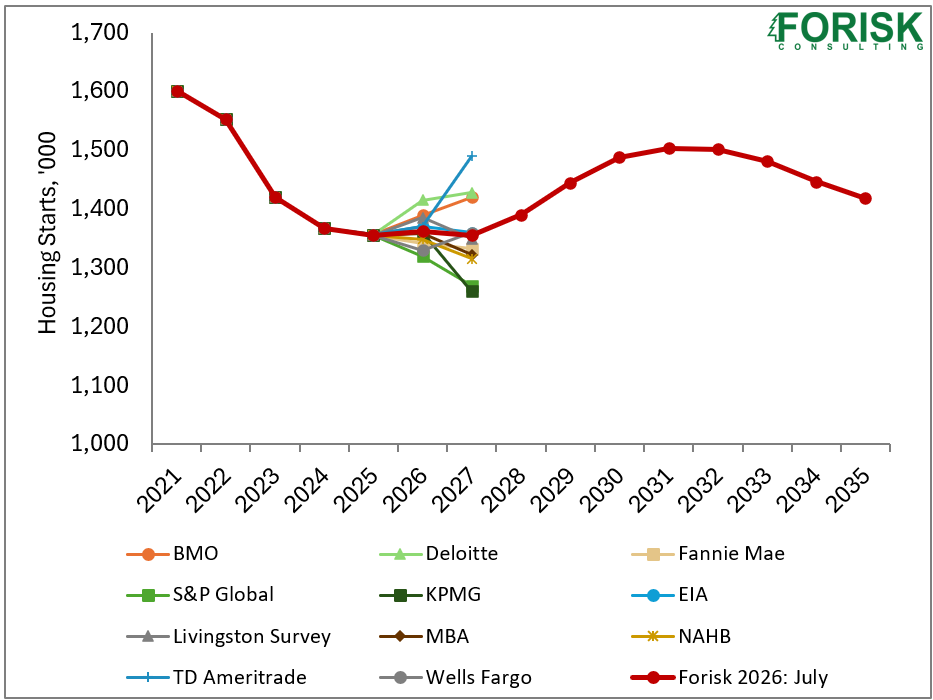
Data Sources: BMO, Deloitte, EIA, Fannie Mae, KPMG, Livingston Survey, Mortgage Bankers Association (MBA), National Association of Home Builders (NAHB), S&P, TD Ameritrade, Wells Fargo.
Methodology
Each quarter when updating our Forisk Research Quarterly (FRQ) forecast models, we revisit prior projections and review applied research on the economy. Forisk’s Housing Starts Outlook combines independent forecasts from professionals in the housing industry. Currently, these include Deloitte, Fannie Mae, the U.S. Energy Information Administration (EIA), KPMG, the Livingston Survey, the Mortgage Bankers Association (MBA), the National Association of Home Builders (NAHB), TD Ameritrade, and Wells Fargo. Forisk applies long-term assumptions from the U.S. Energy Information Administration (EIA) and Harvard’s Joint Center for Housing Studies to establish the peak and trend over the next ten years.
Leave a Reply