
This post includes excerpts from the Q4 2026 Forisk Research Quarterly (FRQ), which includes forest industry analysis and timber price forecasts for North America. To learn more or to subscribe to the FRQ, please contact Nick DiLuzio (ndiluzio@forisk.com).
Forisk surveys private landowners and managers in the U.S. West and South to track the intensity, variance, and diversity of timberland management activities. These silviculture surveys are distributed to private firms responsible for at least 10,000 acres of timberland. Our coverage includes five western states and 12 southern states. Started in 2012, the southern survey is distributed every other year[1], covering costs and practices for the previous year. The western survey started in 2017 in alternate years from the southern survey. The 2026 Western Silviculture Survey, completed this summer, covered over 8 million acres of western privately-owned timberlands. When compared against Forisk’s North American Timberland Owner and Manager List, which also tracks private entities with at least 10,000 acres under management, survey respondents since 2019 consistently represented over 35% of the private investment-grade timberlands in the U.S. The surveys include 49% of the investment-grade acres in the 17 states they cover. The surveys represent among the best available data series on industrial and institutional silvicultural activities.
Regional Silvicultural Trends Converging?
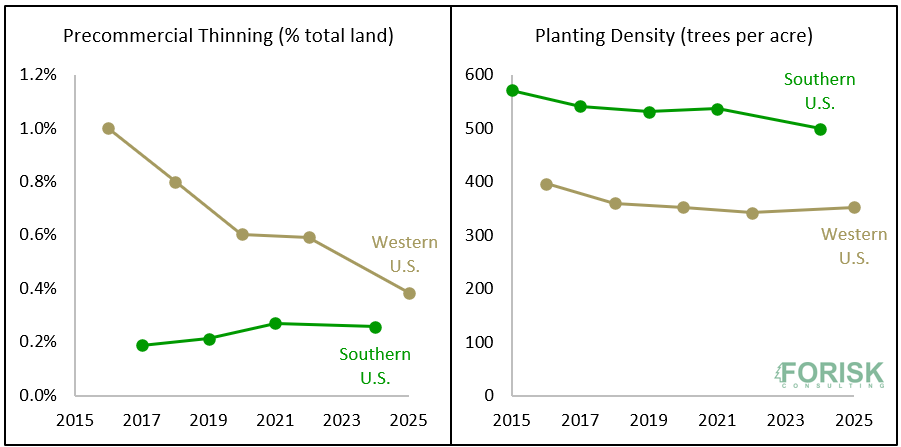
Compared across regions and years, the data can highlight useful trends. As low-value fiber markets weaken in the South, landowners are lowering planting densities to reduce future reliance on pulpwood-only thinnings and considering precommercial thinning to address over-stocked current stands. Southern planting density is dropping, with the reported 2024 density at 500 trees per acre, down 13% from 2015, and conversations with managers suggest 2026 density will be even lower.
The West may offer a preview. Western Douglas-fir planting density fell from 400 trees per acre in our 2017 survey to around 350 (Figure). With the high cost of harvesting smaller trees and pulp markets calibrated towards residual chips, precommercial thinning remains more common in the West than commercial thinning (six times as many acres in 2025). However, the share of the Western land base precommercially thinned fell from 1% in 2016 to less than 0.4% in 2025. Southern precommercial thinning, at less than 0.3% in 2024, is already close to this level. Fewer trees planted means less required thinning, which may explain the West’s decline in precommercial thinning. Southern managers are considering the same shift.
[1] No survey was sent in 2024, offsetting both series by one year.
Leave a Reply