
This post includes excerpts from the Q4 2026 Forisk Research Quarterly (FRQ), which includes forest industry analysis and timber price forecasts for North America. To learn more or to subscribe to the FRQ, please contact Nick DiLuzio (ndiluzio@forisk.com).
Year-to-Date Housing Activity
Seasonally adjusted annual rates (SAAR) for U.S. housing starts averaged 1.293 million in Q3, down 3.9% from Q2’s 1.345 million SAAR and down 8.8% from Q1. Starts averaged 1.352 million through the first nine months of 2026. Rising mortgage rates appeared to cool September activity. NAHB reports builder sentiment at 14-year lows, offering little promise of a near-term recovery. Building permit activity increased 1% from Q2 2026 and rose 1% year-over-year.
Recent research from the Harvard Joint Center for Housing Studies (JCHS) highlights additional headwinds for housing growth. As the oldest Baby Boomers begin turning 80 in 2026, existing housing turnover is set to increase. Lost households among those 55 and older are anticipated to increase from 1.3 million per year over the last decade to 1.6 million per year over the coming decade. That translates to 300 thousand fewer net household formations per year relative to the past decade’s pace. Younger generations remain the engine of new demand at a projected 2.4 million household formations per year, but rising losses now offset two-thirds of that growth. More existing homes hitting the market as the Baby Boomers age could lower housing starts or, if those houses need work, increase remodeling and repair demand.
In a separate analysis, JCHS points out that the rapid decline in immigration since 2024 is likely to lower housing demand over the next two years as well. Most immigrants form a new household within one to two years after arriving. Household formation among recent U.S. immigrants is anticipated to fall from around 570 thousand in 2025 to 143 thousand in 2027 if current immigration rates continue.
Near-term Housing Outlook
Our composite housing starts outlook projects a 0.7% decline to 1.35 million units in 2026, followed by a further 2% decline to 1.32 million units in 2027 (Figure 1). The outlook for 2027 housing starts is 36 thousand fewer starts than our Q3 2026 forecast. Among published Q3 housing forecasts compiled to calculate our composite outlook, only 3 of 11 forecasts anticipate a 2027 increase in housing starts. Forecasts for 2027 remain uncertain with a spread of 190 thousand starts between the highest and lowest forecasts. By 2028, the spread increases to 230 thousand starts, despite fewer forecasts projecting that far.
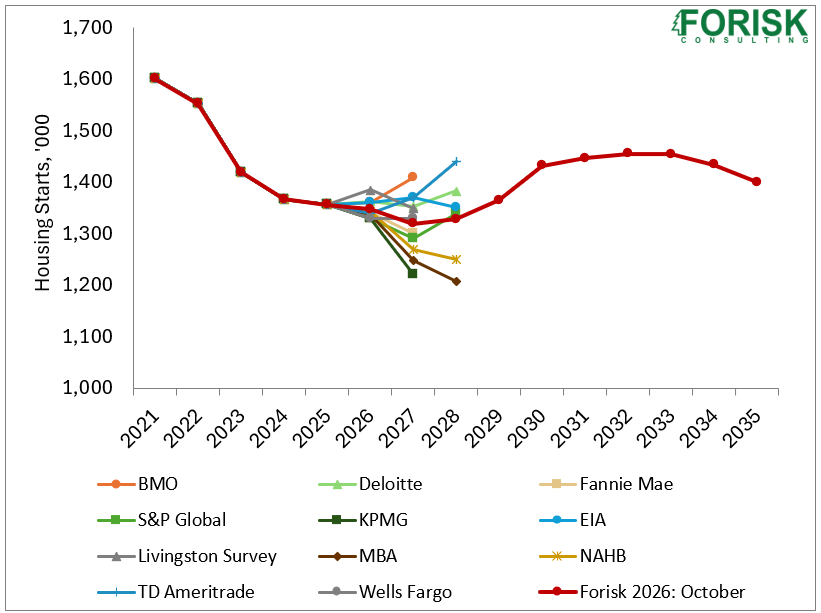
Data Sources: BMO, Deloitte, EIA, Fannie Mae, KPMG, Livingston Survey, Mortgage Bankers Association (MBA), National Association of Home Builders (NAHB), S&P Global, TD Ameritrade, Wells Fargo.
Methodology
Each quarter when updating our Forisk Research Quarterly (FRQ) forecast models, we revisit prior projections and review applied research on the economy. Forisk’s Housing Starts Outlook combines independent forecasts from professionals in the housing industry. Currently, these include BMO, Deloitte, Fannie Mae, the U.S. Energy Information Administration (EIA), KPMG, the Livingston Survey, the Mortgage Bankers Association (MBA), the National Association of Home Builders (NAHB), S&P Global, TD Ameritrade, and Wells Fargo. Forisk applies long-term assumptions from the U.S. Energy Information Administration (EIA) and Harvard’s Joint Center for Housing Studies to establish the peak and trend over the next ten years.
Leave a Reply